history·Edition v1[CONSENSUS VERIFIED]·14 min read
The Fall of Constantinople, 1453: End of the Byzantine Empire
Constantinople, founded as Byzantium and refounded as the Roman capital in 330 AD, served for more than a millennium as the centre of the East Roman or Byzantine Empire [claim:fe00bf15-09a1-14f2-5360-bd295c86df15] [claim:d02dbc1a-23a1-9620-849b-4b376f86cb1e] [claim:c5b29d19-7f8a-cca2-6741-0a3207fe6626]. Known today as Istanbul in Turkey [claim:d98f4020-3526-a12c-8412-23772998c1d1], the city was weakened by its capture in 1204 and partial restoration in 1261 before facing a final Ottoman siege in April-May 1453 [claim:3fa26389-7026-05c9-f74b-727f324b38d2] [claim:ca086cdb-3e6c-2a22-c3b1-6820a1d69b20] [claim:3d30ddb5-648e-0d1d-9ab5-6a0af5794f98]. The siege, opened on April 5, 1453 and closed with the city's fall on May 29, 1453, pitted the forces of Sultan Mehmed II against Emperor Constantine XI and a small multinational defence [claim:c71c21b9-17f6-2b36-8def-5a6bebda5efc] [claim:84525205-06d2-ddc2-23e4-ad9645ee7741] [claim:c616dd2e-3d6e-d911-1baf-18dd94bd65cf]. Breaching by sustained bombardment decided the outcome and the event is understood as terminating the Byzantine Empire and inaugurating the city as Ottoman imperial capital [claim:74605a28-e305-e850-d95f-2666006e61c6] [claim:cc0db50a-7511-8e6f-838c-882b8a394db4] [claim:6757a213-7ffa-f349-86a5-490d2689bc1d]. Accounts differ sharply on troop totals, defender totals, artillery details and the conduct of the sack, requiring careful attribution throughout.
Illustration: The Fall of Constantinople, 1453: End of the Byzantine Empire · ⌁ Sourced: ai-generated
City of Three Names: Byzantium to Istanbul
Illustration: City of Three Names: Byzantium to Istanbul · ⌁ Sourced: ai-generated
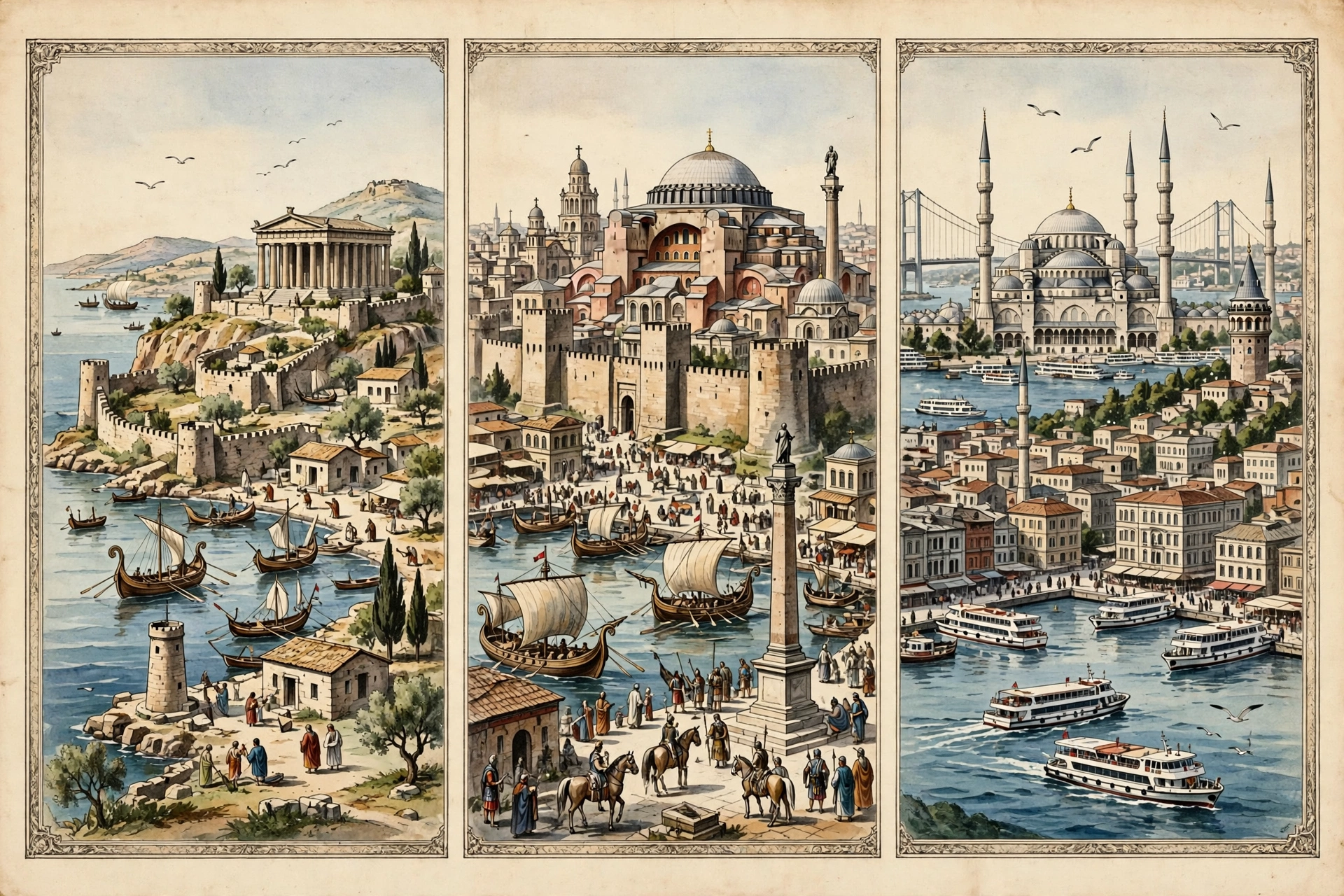
The ancient city of Byzantium was later renamed Constantinople. Constantinople is today known as Istanbul in Turkey. Constantinople was dedicated as the new capital of the Roman Empire in 330 AD. Constantinople was dedicated by the Roman Emperor Constantine the Great. Such a sequence condenses a profound transformation of identity, authority and place into a single continuous urban biography.The layering of names reflects successive claims to legitimacy rather than mere linguistic change. The earliest layer preserves memory of a pre-imperial foundation with its own civic traditions. The middle layer records deliberate imperial refoundation through formal dedication and transfer of capital status. The most recent layer records absorption into a different imperial order and national framework. Each transition therefore invites reflection on how naming practices stabilize new political realities.Continuity of site combined with discontinuity of regime helps explain the city's exceptional symbolic weight. A single harbour, peninsula and wall circuit could carry multiple universalist projects without losing locational advantage. Observers often treat such persistence as evidence of underlying geographic logic. At the same time, repeated renaming shows that geography alone never settled questions of belonging or sovereignty.The dedication act itself illustrates how foundation could be performed as legal and ceremonial work. Designation as new capital reordered administrative hierarchies, fiscal flows and ceremonial itineraries. Attribution to a single founder concentrated responsibility and memory in an eponymous figure. Later recollection of that moment thus served both as historical explanation and as charter for subsequent privilege.
Centre of an Empire for More Than a Millennium
Illustration: Centre of an Empire for More Than a Millennium · ⌁ Sourced: ai-generated
Constantinople functioned as the centre of the East Roman (or Byzantine) Empire for over 1000 years. The Fall of Constantinople led to the end of the Byzantine Empire. The pairing of extraordinary duration with definitive termination frames the entire narrative arc from foundation to conquest. Longevity and finality together account for much of the fascination surrounding the subject.Duration on this scale suggests capacities for adaptation, recovery and institutional reproduction. A centre that endures through schism, invasion, dynastic change and economic fluctuation must continually renegotiate its relationship with provinces, armies and churches. Such resilience can appear almost structural when viewed retrospectively. Yet the same retrospect makes collapse seem all the more consequential because so much continuity is broken at once.The notion of centrality itself deserves careful unpacking. To function as a centre implies concentration of court, patriarchate, arsenal, mint and market within defensible walls. It also implies recognition by outsiders as the address for diplomacy, tribute and challenge. Loss of such a centre therefore reverberates far beyond the fate of its buildings. It reconfigures networks that had oriented themselves toward it for generations.Interpreting an ending after a thousand-year span encourages reflection on periodization. Endings of this kind are rarely sudden in their causes even when sudden in their military conclusion. They invite attention to cumulative weakening alongside proximate shocks. They also invite debate about whether what ends is a state, a civilization, or primarily a capital city that embodied both.
First Fall and Partial Restoration: 1204 and 1261
Constantinople first fell to the Frankish knights of the 4th Crusade in 1204. The city was later liberated under the Paleologi Dynasty in 1261. The interval between capture and liberation marks a rupture after which full recovery was never achieved. This earlier cycle of loss and return prefigures the final siege while remaining distinct from it.The significance of an intra-Christian capture lies in its corrosive effect on trust and resources. Walls that had repelled external besiegers proved permeable to an expedition originally framed as holy war. Plunder and political fragmentation depleted treasuries, dispersed relics and manuscripts, and multiplied competing claimants. Restoration under a new dynasty therefore inherited a diminished fiscal and demographic base.Liberation in this context meant reoccupation and relegitimation rather than restoration of former scale. A dynasty could reclaim palaces and churches without reclaiming hinterlands, revenues or naval dominance. The restored polity faced pressure on multiple frontiers while carrying the memory of humiliation. Such conditions narrow strategic options and increase dependence on fragile alliances.Viewed over the long term, the episode illustrates how a single catastrophic sack can produce enduring structural weakness. Physical damage to infrastructure compounds institutional damage to legitimacy. Even energetic rulers find that lost artisans, lost territories and lost credibility are difficult to reassemble. The eventual fall thus appears not as an isolated event but as the culmination of a vulnerability first exposed two and a half centuries earlier.
Sovereigns and Commanders: Mehmed II, Constantine XI and Giustiniani
The last Emperor ruling in the final years before the fall was Constantine XI. Constantine XI Palaeologus was a Byzantine emperor who reigned 1449-1453. Mehmed II was an Ottoman sultan who reigned 1444-1446 and 1451-1481. Giovanni Giustiniani was a Genoese soldier who assisted the Greeks during the siege. Together these biographical markers define the personal leadership on both sides of the walls.The contrast in reign patterns is instructive for understanding initiative and inheritance. A reign dated 1449-1453 denotes a brief tenure ending in catastrophe, with little time to reverse structural decline. A split reign dated 1444-1446 and 1451-1481 denotes interruption followed by consolidation, allowing youthful ambition to mature into sustained planning. The asymmetry helps explain why one side could dictate tempo while the other managed scarcity.The presence of a Genoese professional alongside the imperial household highlights the international and mercenary dimension of the defence. Assistance from outside the imperial kin group brought expertise, reputation and a small but disciplined following. Such figures often exercised influence disproportionate to their numbers because they embodied links to wider maritime networks. Their participation also underscores the extent to which the defence depended on voluntary commitment rather than imperial command alone.Leadership in a siege involves distinct burdens that differ from open battle. The besieger must coordinate engineers, gunners, sailors and infantry across weeks while maintaining supply and discipline. The besieged must allocate dwindling food, rotate exhausted watches and sustain morale under bombardment. Naming the principal commanders therefore does more than satisfy prosopography; it anchors analysis of decision-making under extreme constraint.
Strangling the City: Trade, Forts and Blockade
According to one account, almost a year before the attack, Mehmed controlled and restricted all trade routes around Constantinople. Mehmed maintained a strict blockade of the City from his new naval forts. Mehmed II built forts to control the naval approaches to Constantinople. The sequence from distant interdiction to close blockade describes a deliberate strangulation preceding direct assault.The claim of comprehensive control over all routes should be read with caution because universals of this kind are prone to overstatement. Restriction could have varied by season, commodity and enforcement capacity. Even partial interdiction, however, would have raised prices, discouraged relief convoys and signalled resolve. The psychological effect of encirclement may thus have mattered as much as the material shortfall.Forts designed to command narrows and approaches translate strategic intent into durable infrastructure. Unlike a temporary patrol, a fortified work can impose tolls, shelter garrisons and mount artillery throughout the year. From such positions a strict blockade becomes administratively feasible rather than merely aspirational. Control of approaches also forestalls reinforcement by sea, which for a maritime city is often the only viable lifeline.Blockade as method bridges economics and warfare. It weakens defenders before a shot is fired against the main walls while testing the besieger's own logistical organization. Success depends on coordination between landward earthworks, seaward patrols and diplomatic deterrence of potential rescuers. Failure to maintain vigilance at any point can allow a convoy to slip through and prolong resistance disproportionately.
Artillery and Engineering: Earthworks, Bombardment and the Royal Gun
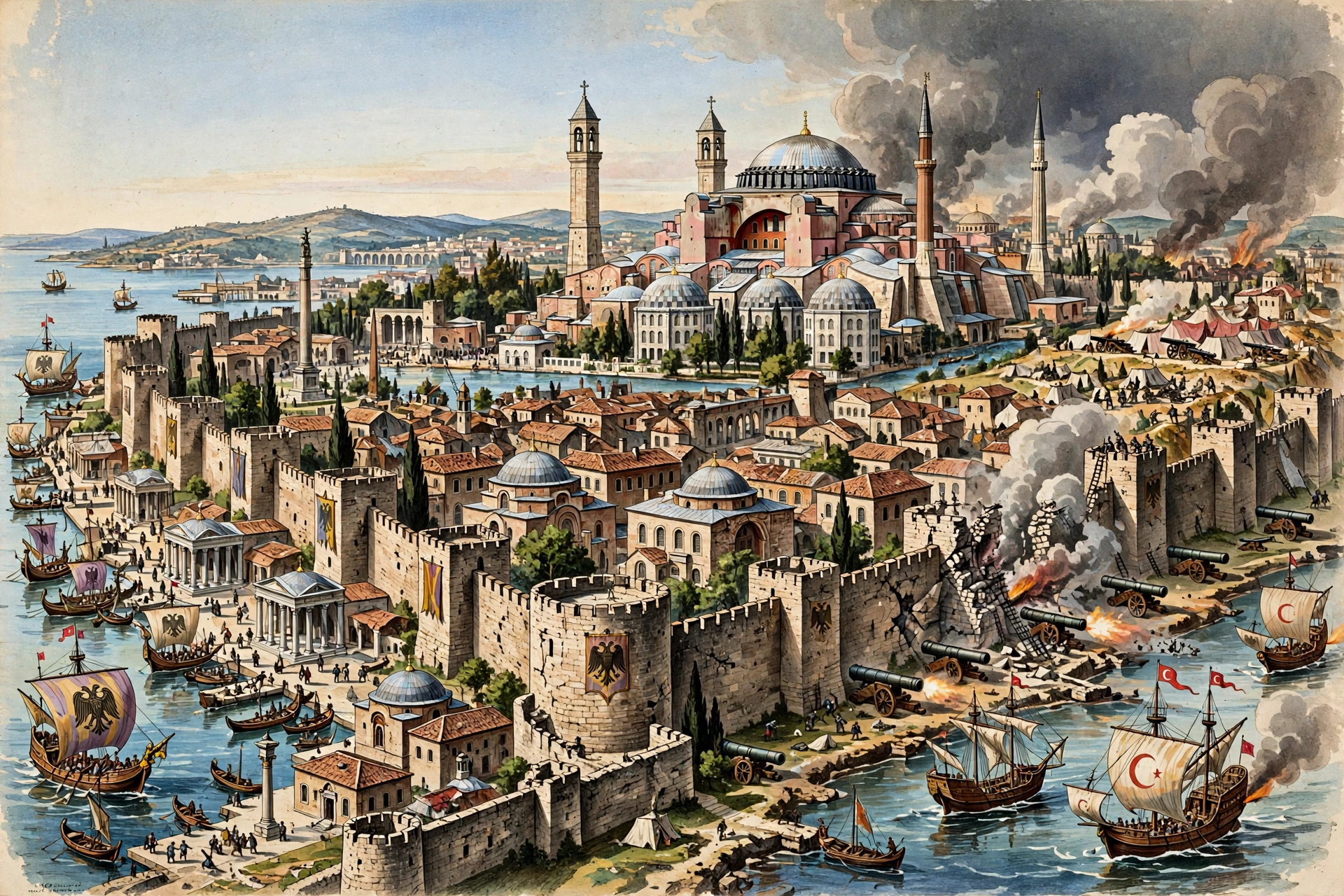
Mehmed built earthworks to surround the city and support the establishment of heavy artillery. According to one account, with the help of the Hungarians, Mehmed built the largest canon in the world. According to a second account, the Ottomans used a massive cannon known as the Royal One to breach the city's walls. A part of the walls was finally breached under constant bombardment. Together these statements trace a causal chain from field engineering through firepower to structural failure.Earthworks surrounding a fortified city serve multiple overlapping functions that go beyond simple shelter. They provide level platforms for recoil-heavy pieces, protect gun crews from sorties, and define lines of circumvallation against relief. Their construction requires mass labour, timber and earthmoving over an extended perimeter. Completion of such works therefore signals commitment to a prolonged operation rather than a coup de main.Claims involving superlatives and proper names for artillery demand particular scrutiny because technical marvels attract embellishment. Attribution to foreign expertise reflects a plausible pattern of skill transfer while also dramatizing ingenuity. Naming a single piece as decisive simplifies a complex gunnery system into a memorable emblem. Historians agree that heavy bombardment mattered, while accounts differ on dimensions, founders and individual responsibility.The mechanism of breaching by sustained fire illustrates cumulative rather than instantaneous effect. Repeated impact dislodges facing stones, exposes rubble cores and widens fissures that defenders struggle to repair under fire. Even a partial breach transforms the tactical problem by concentrating both assault and defence on a narrow sector. Once such a lodgement is achieved, the moral balance of a siege can shift abruptly despite weeks of prior stalemate.
The Defence: Citizens, Mercenaries and Ships
One tradition describes Constantine as left to rule over a deserted city protected by only five thousand citizens. Constantine was supported by a small army of Genoese mercenaries. The same tradition that notes Genoese support identifies Giovanni Giustiniani as the Genoese soldier who assisted the Greeks, linking mercenary aid to a named commander. Such a portrait emphasizes abandonment mitigated only by professional outsiders.Accounts differ on the precise total of defenders. One estimate holds that the defenders numbered only about 7,000. A competing estimate holds that the beleaguered Byzantine legions numbered some seven to eight thousand supported by fifteen ships. The lower citizen-only figure conflicts structurally with the higher combined totals, and evidence suggests that pre-siege population figures varied widely with definitions of combatant, resident and refugee. Precision on this point should therefore be treated as approximate rather than exact.The naval component of the defence, though small, carried disproportionate importance for a city bounded by water. Fifteen supporting vessels could contest a blockade, escort supply craft and shift men along the sea walls. Their effectiveness depended less on numbers than on seamanship, chain-and-boom defences and favourable winds. Even a handful of ships, if well handled, could force a besieger to divert substantial resources to watch every inlet.The social composition implied by citizens plus mercenaries illuminates problems of command and cohesion. Citizens fight for homes, families and faith but may lack training and equipment. Mercenaries bring discipline and experience but fight under contract and divided loyalties. Blending these elements under bombardment requires leadership that can distribute honour, pay and danger credibly. The image of desertion surrounding steadfastness captures this tension between demographic exhaustion and tenacious resistance.
The Besiegers: Numbers, Ships and Deployment
Accounts differ on Ottoman strength. One account holds that Mehmed began his siege of Constantinople in April 1453 with 150,000 troops at his disposal. A competing account holds that the sultan mustered more than one hundred thousand men, including the elite Janissaries. Army-size figures of this era were often inflated, and historians agree that the besiegers vastly outnumbered the garrison even while disputing exact totals. The disagreement concerns scale rather than the fact of overwhelming superiority.According to one enumeration, the defenders saw 493 Turkish ships sail into the Bosporus. Precise large ship counts of this kind show high variance and are historically subject to inflation through double-counting of transports, galliots and auxiliaries. The figure nonetheless conveys the impression of naval saturation experienced from the walls. Even discounted, it denotes a fleet capable of simultaneous demonstration, transport and blockade.The Turkish troops stretched in a line from the Sea of Marmora to the Golden Horn. Such a deployment describes investment of the landward front from sea to sea, sealing the triangle of the historic peninsula. A continuous line facilitates communication, prevents sorties and allows concentration against chosen sectors. It also exposes the besieger to supply strain and disease across an extended camp.Inclusion of elite infantry within the larger host indicates qualitative as well as quantitative advantage. Household troops provide a reliable reserve for the decisive assault after provincial levies and irregulars have exhausted defenders. Their presence allows a commander to rotate fresh formations against tired watches. The combination of mass, fleet and guard thus embodies a mature imperial military system brought to bear on a single objective.
Fifty-Four Days: Investment, Endurance and Breach
On the morning of April 5, 1453, the city was besieged by a formidable Ottoman army. Mehmed's siege of Constantinople lasted for 54 days. The Fall of Constantinople occurred on May 29, 1453. Dated onset, measured duration and dated termination together provide the chronological spine for all detailed narration.An early-April investment allowed the besieger to exploit lengthening days and calmer seas for gunnery and transport. The defenders, amazed at the scale arrayed outside high walls, faced the task of manning an extensive circuit with depleted numbers. Initial days typically involve formal summons, emplacement of batteries and probing attacks. The outcome at this stage remains radically uncertain despite apparent odds.Endurance over nearly two months testifies to effective leadership, repair organization and rationing on the defensive side. Dwindling supplies and fatigue progressively erode combat power even when courage remains intact. Each breach repaired by night invites renewed bombardment by day, creating a war of attrition along the parapet. The ability to sustain such effort for fifty-four days therefore commands respect independent of final result.Closure on a late-May date transforms a process into an event suitable for commemoration. A single day concentrates memory of weeks of labour, fear and negotiation into a dramatic climax. Anniversaries can then anchor liturgy, historiography and national narrative. The precision of day-month-year dating facilitates that mnemonic function while inviting verification against contemporary calendars and reports.
Fall and Aftermath: Death, Sack and Imperial Capital
Emperor Constantine died while fighting in battle on 29 May. After the fall, the city was established as the capital of the Ottoman Empire and renamed Istanbul. The conjunction of a sovereign's death in combat with immediate refoundation as a new capital dramatizes regime change as both personal tragedy and institutional transfer. It explains why the date functions simultaneously as obituary and inauguration.According to one account, following the fall, Mehmed allowed three days and nights of murder, rape and pillage by his Turkish soldiers. Such atrocity-plus-authorization claims carry the highest risk of embellishment and require elevated independent corroboration. The defined duration of three days and nights follows a conventional formula for licensed sack, which may reflect normative expectation as much as observed fact. Evidence suggests caution before treating the scope and authorization as firmly established.According to the same narrative tradition, Mehmed rode into the Cathedral of Hagia Sophia on a horse. Highly symbolic desecration images of this kind are prone to elaboration in post-conflict storytelling. The scene condenses conquest, humiliation and sacral appropriation into a single tableau. Without additional corroboration, it is best understood as reflecting how the fall was remembered rather than as a securely documented act.Institutional consequences, by contrast, rest on firmer ground. Establishment as Ottoman capital redirected patronage, population policy and monumental construction toward the conquered city. Renaming formalized the transfer while preserving the site's centrality under new management. Cultural and geopolitical shifts initiated at that moment influenced European and Middle Eastern history for centuries, as networks once oriented toward a Christian capital reoriented toward an Islamic empire.